



cuda.ml is an R package for running common data science and machine-learning operations on NVIDIA GPUs. It provides high-level interfaces for fitting regression and classification models, finding nearest neighbors, clustering observations, reducing dimensions, and running predictions from tree ensembles. You can use its direct R functions or work through parsnip and tidymodels.
cuda.ml is for data scientists who work primarily in R and want to use a GPU without moving their modeling workflow to Python or learning low-level GPU APIs. Version 0.4.0 is a substantial update to the package. It makes installation much simpler, expands tidymodels support, adds more ways to run tree-ensemble models, and makes it straightforward to save and restore supported fitted models.
Install from CRAN#
For most users, setup is two commands:
install.packages("cuda.ml")
cuda.ml::cuda_ml_install()
The package from CRAN is a regular, portable R package.
cuda_ml_install() downloads and verifies the matching compiled backend
and GPU libraries, then keeps them in a cache for later R sessions. On a
supported system, you do not need to compile cuda.ml from source,
configure a Python environment, or assemble the GPU libraries yourself.
The result is a familiar R package workflow: install the package, prepare its supporting libraries once, and start an analysis. The extra installation call is explicit because the GPU libraries are much larger than the R package. Repeated calls reuse the completed cache, and loading cuda.ml itself is quiet and does not initialize CUDA.
Prebuilt support is available for Linux x86_64 with glibc 2.28 or newer. GPU operations require a supported NVIDIA GPU and driver 580 or newer. On Windows, install and run R inside a compatible WSL2 Linux distribution. See the installation guide for the complete system requirements and source-build options.
Use familiar modeling interfaces#
cuda.ml registers parsnip engines for linear, logistic, and multinomial regression, random forests, nearest neighbors, and radial, polynomial, and linear support-vector machines. For example, this fits a random-forest classifier on the GPU using the standard parsnip interface:
library(cuda.ml)
library(parsnip)

forest_spec <- rand_forest() |>
  set_mode("classification") |>
  set_engine("cuda.ml")

forest_fit <- forest_spec |>
  fit(class ~ ., data = modeldata::hpc_data)
predict(forest_fit, modeldata::hpc_data[1:5, ], type = "prob")
# A tibble: 5 × 4
.pred_VF .pred_F .pred_M .pred_L
<dbl> <dbl> <dbl> <dbl>
1 0.309 0.597 0.0666 0.0275
2 0.899 0.0838 0.0138 0.00335
3 0.965 0.0261 0.00850 0.000883
4 0.973 0.0228 0.00416 0.000352
5 0.966 0.0298 0.00416 0.000352set_engine("cuda.ml") selects the GPU-backed cuda.ml engine; the rest
is a standard parsnip workflow. Recipes can learn preprocessing on the
training data and carry it into resampling and prediction.
Work directly with cuda.ml#
cuda.ml also provides a direct R interface. This is useful when you prefer a function-oriented workflow or want to use the package on its own.
library(cuda.ml)
library(ggplot2)

clusters <- cuda_ml_kmeans(scale(faithful), k = 2)
faithful$cluster <- factor(clusters$labels)

ggplot(faithful, aes(eruptions, waiting, color = cluster)) +
  geom_point(size = 2.5) +
  labs(
    x = "Eruption duration (minutes)",
    y = "Waiting time (minutes)"
  ) +
  theme_minimal()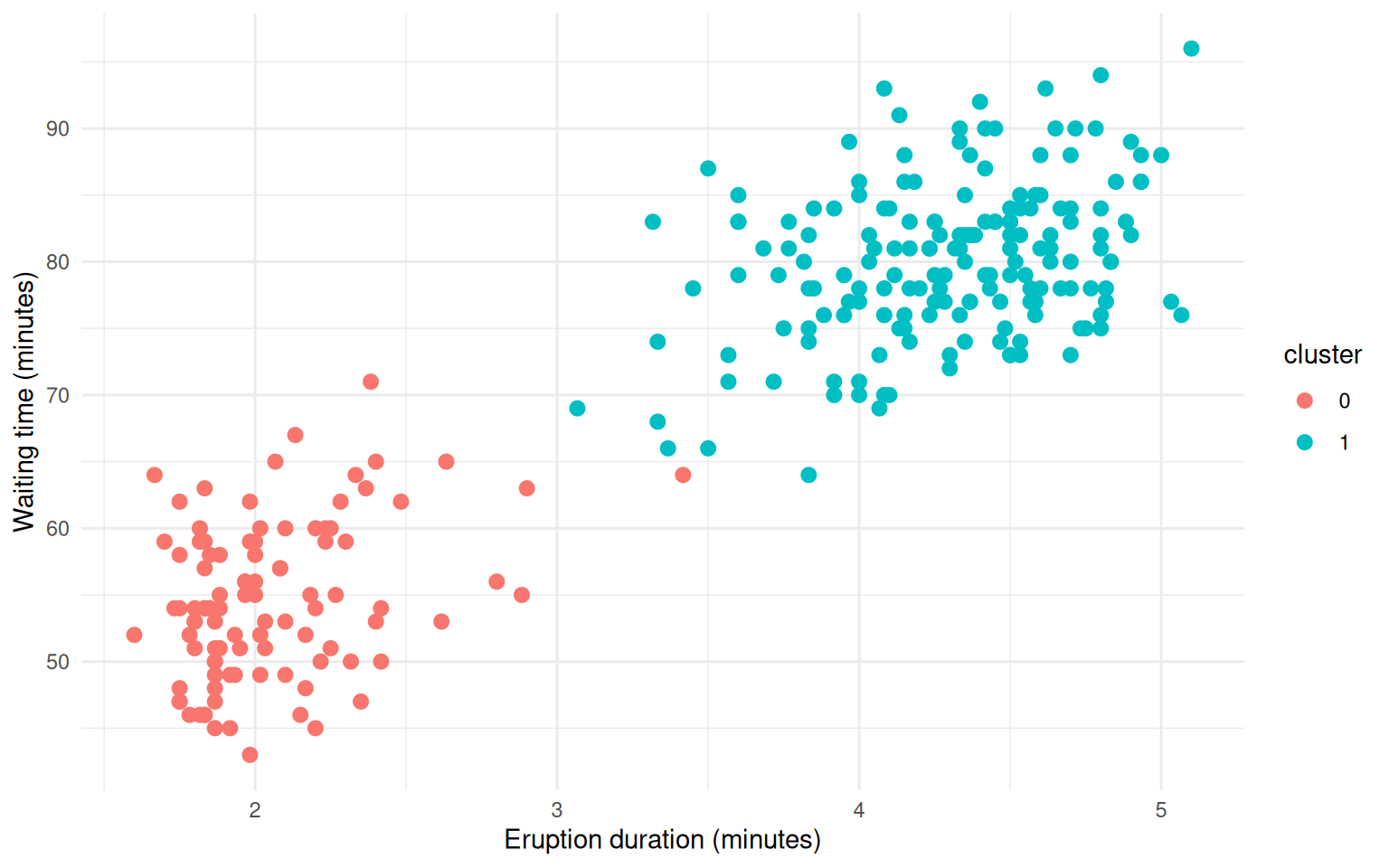
The direct API covers supervised models as well as clustering and dimensionality reduction, including DBSCAN, k-means, PCA, tSVD, UMAP, and t-SNE. It also includes stochastic-gradient-descent regression, the hyperbolic-tangent SVM kernel, and external tree-ensemble inference.
Run tree ensembles on a GPU or CPU#
This release expands where and how you can make predictions with tree
ensembles. The new nvForest support powers prediction for random forests
trained with cuda_ml_rand_forest() and can load trained XGBoost
models, LightGBM text models, and Treelite checkpoints. Once a model is
loaded, the API provides standard prediction along with model
information, leaf identifiers, individual-tree predictions, and
checkpoint import and export.
GPU inference uses the complete cuda.ml installation. A deployment that only needs CPU inference can prepare a smaller, CUDA-free backend:
cuda.ml::cuda_ml_install(device = "cpu")The CPU backend can run a cuda.ml random forest trained on a GPU as well as a supported external tree ensemble. The complete installation can also run these models on a CPU, so the smaller backend is an optional deployment choice.
Save and deploy fitted models#
cuda.ml 0.4.0 expands model persistence for training, analysis, and deployment workflows. Supported fitted models can be saved to a compressed file, restored in another R process, stored as raw bytes, or wrapped with the bundle package.
The simplest file workflow passes a path directly:
model <- cuda_ml_rand_forest(
  class ~ .,
  data = modeldata::hpc_data,
  trees = 100
)

cuda_ml_serialize(model, "hpc-runtime-forest.cuda-ml")
In another R process or deployment environment, prepare cuda.ml and restore the fitted model:
library(cuda.ml)

cuda_ml_install()
model <- cuda_ml_unserialize("hpc-runtime-forest.cuda-ml")

predict(model, modeldata::hpc_data[1:5, ], type = "class")
File paths use gzip compression. Passing connection = NULL instead
returns the state as an uncompressed raw vector of bytes, which is
convenient for object stores and database BLOB columns. The blob package
can represent raw vectors for database workflows, and the bundle package
is supported for teams that already use bundled model artifacts.
Persistence is available for linear models, logistic and multinomial regression, PCA, SVC and SVR models, UMAP, random forests, and nvForest models. cuda.ml checks the saved state and required backend before restoring it. For an nvForest-backed model, the restore call can select CPU or GPU inference.
Highlights for users upgrading from cuda.ml 0.3#
This is a breaking update to the earlier package. The most visible changes are:
- The random-forest API now uses
mtryfor predictor sampling andsample_fractionfor row sampling.treesdefaults to 100, and an omittedseeddraws from R’s random-number generator, soset.seed()controls the fit. - Linear, logistic, and multinomial regression now use numeric
penaltyandmixturearguments that match parsnip. Logistic and multinomial regression are unregularized by default. normalize_inputwas removed from the linear-model functions. It previously requested GPU-side L2 normalization. Use explicit preprocessing such asrecipes::step_normalize()when centering and scaling are appropriate; but please note, the two operations are not numerically identical.cuda_ml_sgd()now fits squared-loss regression only. Itslossargument was removed, andn_iters_no_changeis nown_iter_no_change.- The former FIL interface has been replaced by nvForest. Random projection and the KNN IVFSQ index have no replacement in the pinned upstream API.
See the full changelog for the complete list of API changes.
The guides cover first steps and more complete examples: